Walter Ramos Joins Roger Williams Board to Empower Students and Fortify Senior Care

Walter Ramos, President and CEO of Rogerson Communities, is a proud alumnus of Roger Williams University in Bristol, Rhode Island—and, as of October 10, one of its newest trustees.
The appointment is the culmination of a process that began in 2023 when Brit d’Arbeloff, then Chair of Rogerson’s Board of Directors, invited him to a meeting on campus with Roger Williams’ leadership. That meeting led to guest visits to classes, a seat on the university’s board of advisors, a speech during the 2025 commencement ceremonies, and ultimately an offer to join the board of trustees.
“I thought it was an incredible honor that the place where I went to school saw something in me,” Walter says—and that it wanted him to share his experiences as a way of encouraging students to follow their own paths.
For many college students, their school’s board of trustees is an abstraction at best—high-level people making high-level decisions in a boardroom somewhere. While they advance the institution’s best interests, board members don’t usually figure in the day-to-day experiences of students. But Walter is different. What motivates him the most, he says, is impacting students in the way that his alma mater impacted him.
As a board member, he enthusiastically contributes to the fund that assists students who need financial help. Aid was crucial to his own experience as a student years ago, when his father passed away during his freshman year. With family finances thrown into uncertainty, he made the decision to leave Roger Williams and head back to work.
“And that’s what I told my advisor,” Walter recalls. “I’m going to go work in a supermarket and I’ll go to school at night. He told me, ‘No, you’re not. You’re staying here.’”
Not only did the university grant him enough aid to remain enrolled full-time, but his professors also wrote letters of recommendation that resulted in internships for him in Boston, including one with Senator Edward Kennedy. At the moment he needed it most, the university was there for him. As a trustee, it’s important to Walter to strengthen this kind of support for others.
Scholarships aren’t the only way in which Walter impacts students at Roger Williams, however. He also interacts with them directly through the Mentorship Lab at the university’s Gabelli School of Business. During a recent visit to campus, he spoke with students in the course, describing his role and how Rogerson conducts its business. The surprised reaction of the class, many of whom were business or finance majors, was telling, particularly when it came to discussing career paths.
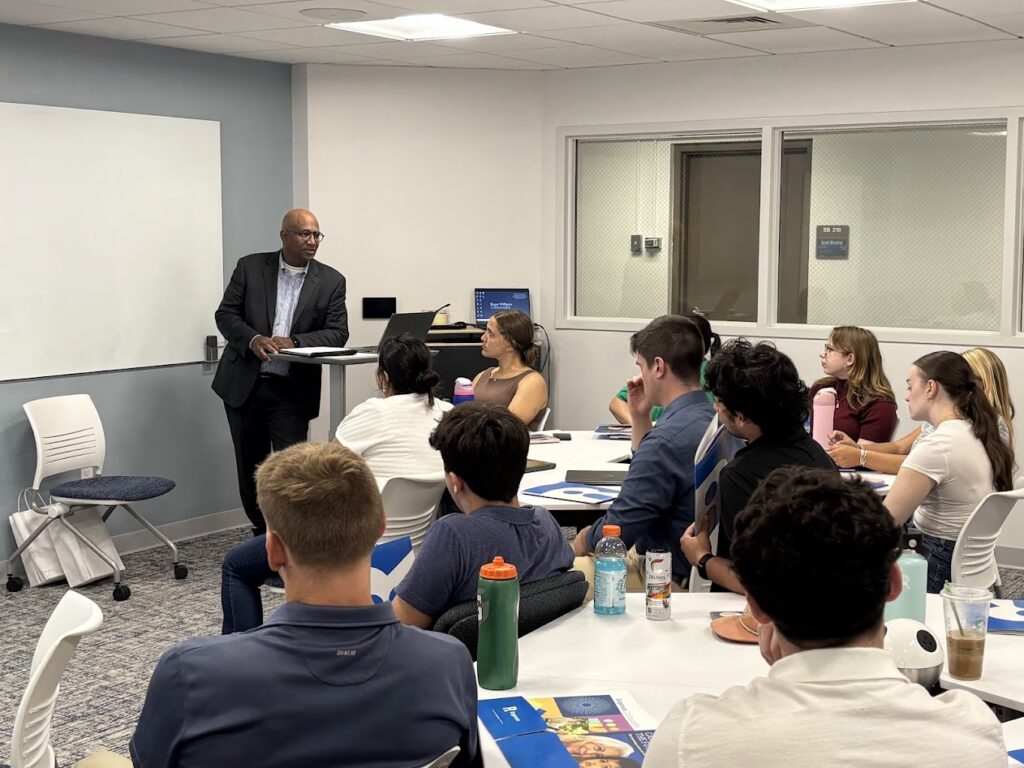
“I don’t think they were aware of all the businesses that are within the senior living space,” Walter says, explaining that caring for large numbers of older adults draws on professions from finance and accounting to real estate, architecture, construction, public health, and more. Most college students, however, don’t usually consider senior care to be so multifaceted.
“People who recruit on campus are the big banks and accounting firms and construction companies,” Walter notes. “Students don’t necessarily know what we do and how their skills could play a big role in it.”
This, in his view, represents a missed opportunity in a uniquely challenging time for senior care. According to the U.S. Census Bureau, one in five Americans will be 65 or older by 2030. That population is projected to nearly double in the coming decades, from 49 million in 2016 to 95 million people in 2060, while the 85+ population could grow more than 200 percent, from six million to 19 million people. And while those older adults will certainly need nursing care, organizations that employ the nurses will require a wide variety of professionals to run them, many of whom are sitting in college and university classrooms today.
“We’ve got to go and get that generation,” says Walter. “I think the only way to do that is to get in front of them.”
As a participant in the Mentorship Lab, Walter has been paired with a student mentee, a finance major with a business minor. In addition to meeting weekly via Zoom to hear updates on Walter’s work, his mentee will be getting face time with many other professionals at Rogerson in the coming months during an internship at the organization’s headquarters in Boston. He will work with staff in the finance and advancement offices, learning firsthand how to apply his skills for the benefit of the senior care world. It’s a win-win arrangement, extending Rogerson’s hiring pipeline into a pool of young talent that the field sorely needs, and also opening new horizons that the mentee and his classmates hadn’t even considered.
“Walter has broadened our students’ understanding of the promise and value inherent in careers that make a meaningful impact on others,” says Kate Hall, Lecturer in Management, who leads the Mentorship Lab. His work, she says, exemplifies “both the impressive professional achievements of our alumni and the importance of giving back to the communities one is part of.”
For Walter’s part, he hopes this style of outreach and interaction catches on with other leaders in the senior care field, saying it represents a crucial path forward through an uncertain future.
“This is part of your job: Go and bring in a new generation. It’s the sustainability of your organization… because if you don’t have the people, you can’t take care of people.”