Caring for Those Who Care
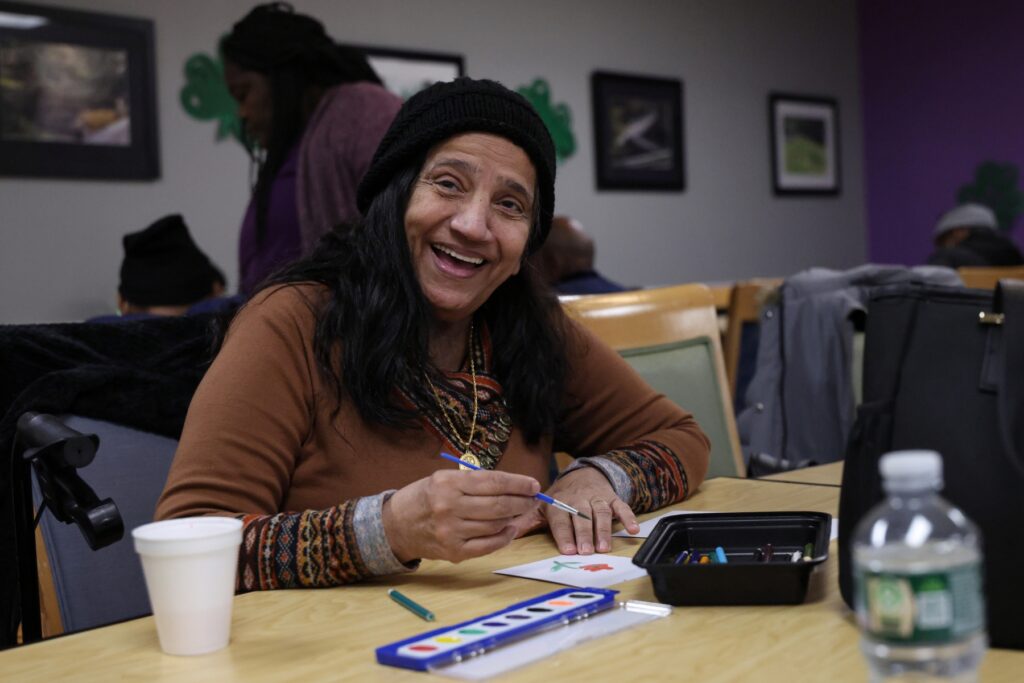
Mumtaz Budwani’s life has been one of transitions: from her native Bangladesh to the United States; from Chicago, where she spent much of her adulthood, to Boston; from mother to grandmother. And from a teacher, depended upon by hundreds of families to educate, nurture, and care for their children, to an older adult in need of care herself.
For Mumtaz, who now lives in Boston with her daughter, that means depending on family for support. But her daughter and son-in-law—both physicians, and parents to small children of their own—have limited capacity to provide the care and attention that Mumtaz deserves. That’s why she boards a Rogerson van outside her home every weekday morning to head to the Adult Day Program in Roslindale. She’s been attending for the past three years.
There, trained nursing staff support her—and her fellow participants—with hands-on personal care and health management throughout the day, including medication provision and vital sign monitoring. This personal care is delivered with a personal touch, something Mumtaz says she appreciates.
“The people are very helpful—very nice ladies,” she shares. “The minute we enter, they give us coffee, there’s breakfast. These are very warm people, so it makes our lives easier.”
Physical activity is an important part of her daily routine at ADH. With the assistance of a professional trainer, she exercises in the Fitness FIRST studio, where participants work on maintaining strength, balance, and mobility. She spends at least half an hour there every day using equipment like the stationary bicycle. Mumtaz says she feels the difference, and that others notice as well, telling her she looks more physically active than when she first came to the ADH program.
Mumtaz appreciates other aspects of the program as well, including bingo games, crafting activities, and birthday celebrations. There are off-site trips to restaurants and retail stores, and to sightseeing attractions that allow her to experience parts of Boston she’d never visited before. A recent favorite was a breezy summer day at Castle Island in South Boston.
Services like these are part of the reason why Rogerson’s ADH program, and others like it, play an increasingly vital role in older adult care. As costs for other forms of care like assisted living continue to climb, adult day health programs often represent an alternative that provides many of the same benefits at a lower cost. According to the Massachusetts Adult Day Services Association (MADSA), the average annual cost to MassHealth for a full year of ADH is less than $19,000, compared to more than $72,000 for nursing home care—an annual savings to the state of some $53,000 per person. Ensuring that older adults remain healthy, active, and engaged this way while living independently is also far less expensive for the state than home health care, per MADSA.
One of the most impactful aspects for Mumtaz, however, has been one that most might take for granted—simply being around other adults her age.
“I learned childhood education and development,” she says, explaining how her 40-year career in Montessori schools gave her deep insight into what she calls the “nature” of children.
“If you are among people, you know what nature they have. But because I was a teacher for 40 years, I couldn’t guess what kind of nature adults have. To see older people, how they behave, how they interact, is very different.”
That kind of stimulation, the social experiences that come with being in a community setting, is important not just to an aging mind, but to overall health. The National Institute of Health notes that research has linked social isolation and loneliness to higher risks for a range of physical and mental conditions, from high blood pressure and heart disease to anxiety, depression, cognitive decline, and even death.
For her part, Mumtaz says that if it were not for ADH, she would likely spend her days sitting at home, watching television or looking out the window.
“If I don’t come” to ADH, she points out, “I feel lonely. I feel like something is missing.”
Even as she enjoys new relationships and experiences in the ADH program, however, Mumtaz’s nurturing instinct for children remains as strong as ever. When she participates in art and crafting activities at Rogerson, for instance, it’s not just a way for her to pass the time during the day. She tucks those projects away in her memory and uses them to strengthen bonds with her family.
“I have two granddaughters,” she proudly shares. “And I go home and do those same activities with them.”