Katie Smith Sloan: A Voice for Older Adults
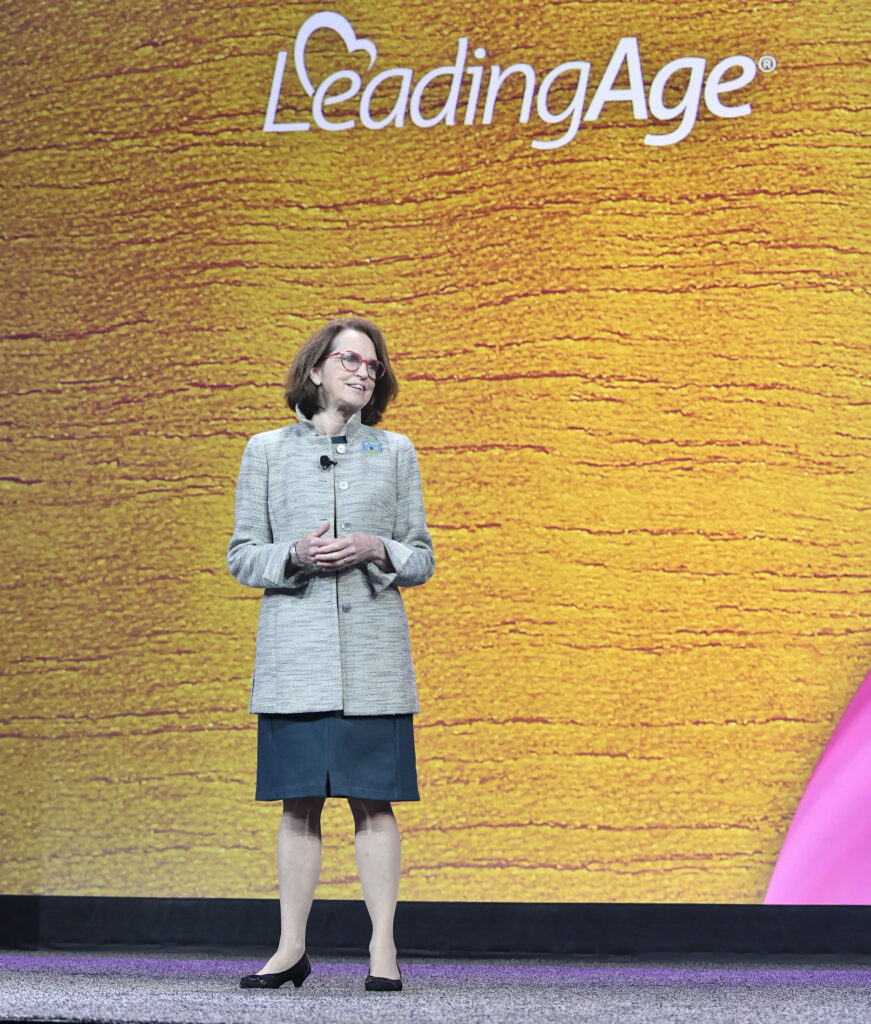
Katie Smith Sloan has built a career on tireless advocacy for older adults, working to improve their health, protect their rights, and elevate their quality of life. Widely recognized for her accomplishments within the field, the president and CEO of LeadingAge is now being honored by Rogerson Communities with a Lifetime Achievement Award, and will deliver the keynote address at Rogerson’s annual Welcome Home Gala.
Early in her career, Katie had an experience that set the direction for her professional life. As a young staffer working in the U.S. Senate, she sat in hearings of the Special Committee on Aging. Older adults gave first-hand testimony of struggles to afford necessities like food, medicine, transportation, and even basic utilities. What she heard there moved her.
“It hit me hard,” she recalls, “and it made me realize that as a country we really don’t do well by our elders.”
She found ways to make practical improvements to the lives of older adults in a subsequent role at AARP. While managing AARP’s programming, she turned on-the-ground observations of the challenges they faced into public policy wins in government, including legal and regulatory reforms in pensions, healthcare, fraud protection, and housing.
Today, as leader of the country’s largest association of nonprofit providers of aging services, Katie marshals the influence of 5,400 member organizations and serves as a voice for older adults among the policymakers of Washington D.C. Increasingly, that voice is raising an alarm.
According to analysis by the Population Reference Bureau, the number of Americans age 65 and older is projected to reach 82 million, representing 23 percent of the total population, by 2050. Additionally, demand for senior care is expected to increase sharply with a rise in the number of Americans living with Alzheimer’s disease, which could more than double by 2050 to 13 million, from six million today.
Numbers like these, according to Katie, add up to a senior care crisis for which the United States is not prepared. In particular, she warns of a growing gap between people who need care and the availability of caregivers, whether family members or professionals.
“We see people discharged from hospitals with no place to go,” she says. “Nursing homes can’t take them because there’s not enough staff or Medicaid doesn’t provide enough financing. Home health agencies seem to be closing right and left. I was just talking with one of our largest home health members, and he turns away 45 percent of referrals because he does not have the staff.”
Given these kinds of historic headwinds, how can providers deliver on their mission to older adults without compromising quality? Noting that staff remain the crucial linchpin of care, Katie encourages providers to focus there, making the most of the staff they have by investing in career advancement paths and training opportunities, which can help reduce turnover. Technological solutions can help too, she notes, including AI platforms that can streamline processes like hiring and data management that impact the overall effectiveness of an organization.
“It’s really about understanding who you’re serving,” she says, “how you’re serving them, and could you do something differently, or better? What are those technologies out there that can create some efficiencies, improve quality in some cases, improve resident engagement?”
Or, Katie notes, providers might sustain themselves in this challenging environment by being open to business opportunities.
“Look at the skills that you have and how can you apply them in different ways to serve different people,” she suggests, like offering care coordination services to younger adults trying to manage their aging parents. While such entrepreneurship may not come naturally to all organizations, diversifying revenue doesn’t have to mean diversifying the mission.
“It’s not like you’re going to go out and create storage units or laundromats,” she says. “You’re going to build on an expertise that you already have.”
Katie is also quick to encourage outreach to the wider community as a means of raising an organization’s profile. She urges providers to seek partnerships with institutions around them, like nursing schools, childcare centers, or even museums. This kind of integration, particularly when it fosters connections between generations, brings benefits that can’t always be quantified on a balance sheet.
“The aging of America is an opportunity,” she says. “It’s an opportunity to tap into the incredible experiences, resources, expertise, and passion of people who have lived long lives, and who we have much to learn from. We need to figure out how to do that well.”