Jeffrey Sacks Takes on the Challenge of Affordable Housing
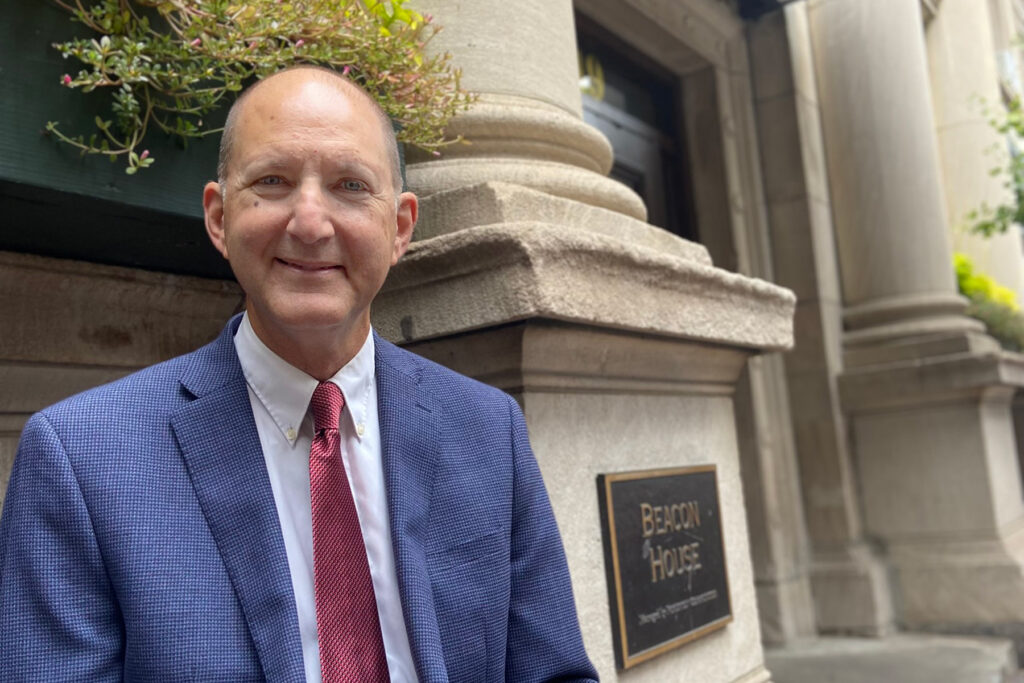
Since the early days of his legal career in Boston, Jeffrey Sacks, partner and senior counsel at the law firm Nixon Peabody, has worked with Rogerson Communities in its efforts to develop affordable housing for older adults. This September, Rogerson will gratefully recognize Jeff and Nixon Peabody for that longstanding dedication with the Charles E. Rogerson Award, the organization’s most prestigious honor.
Jeff’s passion for community-building, however, began even earlier in his life.
“The origin of my interest in this work is really growing up in a city,” Jeff reflects, “and being a city person and thinking about what makes a good city. I love cities, I love density, and I think that’s where the energy comes from.”
Jeff was raised in Brooklyn, New York, and witnessed firsthand the ruinous toll on neighborhoods of the city’s financial tailspin and near bankruptcy in the 1970s. Rather than turning away from such challenges, he helped tackle them as early as he could, as a young college graduate working for the state of New York’s budget division on issues of neighborhood preservation and community redevelopment. Later, at Yale Law School, he saw and studied the devastating effects of urban renewal and highway construction on low-income neighborhoods in New Haven, Connecticut. By the time he moved to Boston to practice law, he was both equipped and motivated to make a positive impact on the affordable housing landscape. Rogerson Communities was an early client.
“One of my first big projects was the redevelopment of a school and a vacant parking lot on Beacon Hill,” Jeff recalls, referring to properties that are now Rogerson’s Peter Faneuil House and Joy Street Residence. These communities, together with Beacon House around the corner on Myrtle Street, represent an early success for Jeff and Rogerson in nurturing affordable housing, particularly for older adults, in the very heart of the city.
“Today, they’re real anchors in that neighborhood,” he notes. “That block is in the middle of the priciest real estate in Boston.”
Affordable urban housing is obviously a boon to tenants and increases demographic diversity in both age and income, but it also helps keep cities vibrant in other significant ways, Jeff explains. Workers who are able to live close to their employers, instead of commuting long distances, are more available and reliable. Similarly, a local customer base can provide a steadier income stream for local businesses. In the end, it can mean the difference between a thriving city economy and stagnation.
These realities have motivated state and local leaders to make affordable housing a public priority through legislation, funding, and research. Here too, Jeff contributes his expertise and energy. Aside from helping to draft amicus briefs in support of the MBTA Communities Act, a 2021 law mandating new multi-family zoning in locales served by public transit, he serves on the Executive Office of Housing and Livable Communities Senior Housing Commission.
“The Commission is working right now on finding additional funding for organizations like Rogerson that provide supportive housing for seniors to keep residents healthy and out of emergency rooms and nursing homes,” Jeff explains.
One of the most important impacts that quality, affordable housing can have on public health is so obvious that it might be easily overlooked: the creation of community, places and opportunities for people to connect with one another. Even just playing cards in a lounge or chatting with a neighbor in a hallway can help to decrease isolation and reduce loneliness, two major social determinants of health. According to the Centers for Disease Control, social isolation and loneliness put a person at risk of developing serious mental and physical health conditions and disproportionately affect both low-income and older adults.
“The kind of programming that Rogerson supports in all of its housing really combats that directly and keeps people engaged,” Jeff says. “I believe that every senior should live in a community with engagement and dynamism. But we have to consciously create these places—they don’t just happen. That’s the business Rogerson is in for low-income folks. And we just need tons more of it.”
