Compassion When It’s Needed Most
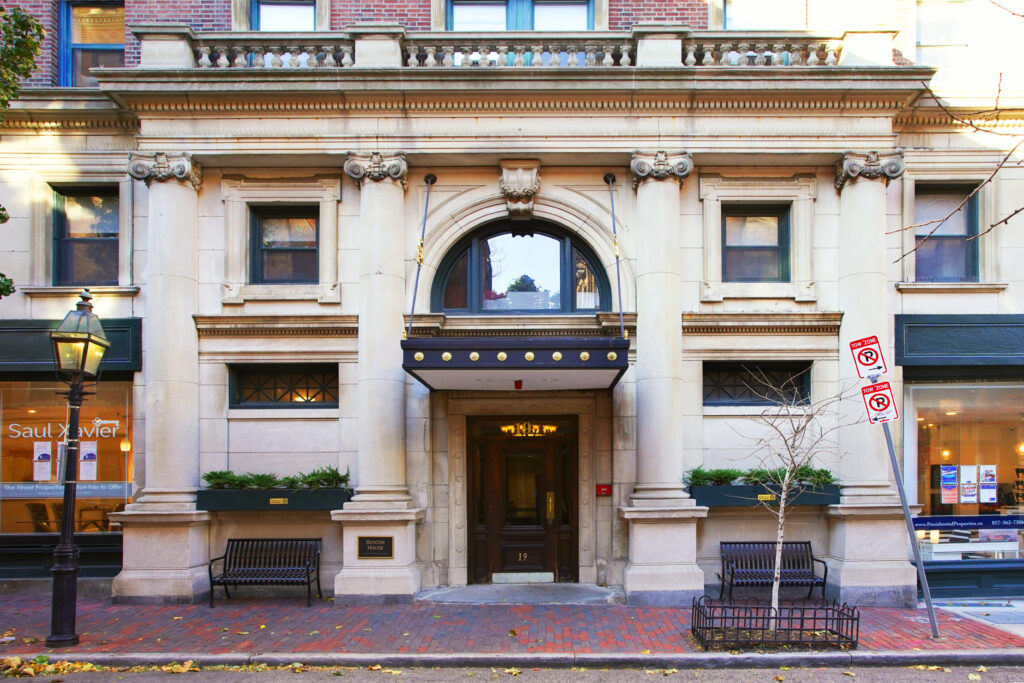
We hear the story far too often: an older adult experiences a health crisis that threatens her financial stability, and even her ability to remain housed. When it happened to Elizabeth, a resident of Beacon House who fell behind in rent due to a hospitalization, her property manager didn’t hound her—she helped her.
Elizabeth built a career on helping others, founding, with her husband, an intermediate care facility for people struggling with mental health and substance abuse disorders. She followed that up by earning a master’s degree and working in a hospital psychiatric department. After the passing of her husband and parents, she spent time at a Buddhist meditation retreat in Wisconsin, where she developed a deep respect for the Dalai Lama and the people of Tibet. Upon returning to Boston, she spent time aiding others through the practice of reiki, a form of alternative medicine, before retiring and living by herself on Beacon Hill, moving into Rogerson’s Beacon House about ten years ago.
“I had just gotten a Section 8 voucher,” Elizabeth shares. “I applied everywhere that they suggested or recommended. And there were a couple of people I knew who lived here. When Beacon House called me and said they had an apartment for me, I absolutely jumped at the chance.”
She has lived at Beacon House ever since, in a neighborhood she loves and in a home she finds peaceful and comfortable. Last year, however, she experienced a medical emergency that required hospitalization and a stay in rehab. While recovering there, her Section 8 certification expired and, through no fault of her own, she was unable to file an appeal for recertification in the time allowed.
Upon returning home, she struggled for months to pay her rent without the assistance of her voucher on a very limited retiree income, and with no family to depend on. After a fall forced her to return to rehab, she found herself falling almost $10,000 behind in rent.
When Beacon House Property Manager Sandra Whigham heard about Elizabeth’s predicament, she was moved to take action, but perhaps not the expected kind. She did not send repeated notices or otherwise pursue Elizabeth for the unpaid rent, because she knew where the situation might lead if she did—to an eviction, a shelter, and perhaps ultimately homelessness. Instead, Sandra began to search for a way to keep Elizabeth in her home.
“On her behalf, I applied online for RAFT,” Sandra recalls, referring to the state’s Rental Assistance for Families in Transition program, which can provide up to $7,000 a year to help Massachusetts residents remain in their homes or find new ones. Even this sum, however, wasn’t enough.
To cover the balance, Sandra did still more work, acting as a liaison among housing assistance and senior service nonprofits Metro Housing, Guardian Angel Senior Services, and Way Finders to make sure the entire outstanding balance was paid for. From reams of paperwork to hours on the phone, it added up to a lot of extra effort for Sandra; but in the end, that work was successful—and the back rent paid in full.
Elizabeth is now out of rehab and settling back into her home at Beacon House, where staff have continued to support her, arranging for meal deliveries and the installation of a wireless medical alert system in her apartment.
For the manager of an independent living residence, much of this work is above and beyond an already demanding job. To Sandra, however, it’s a matter of human decency. According to her colleague Alfreda Payne, Resident Services Coordinator at Beacon House, this kind of effort is natural for those who choose to work with older adults.
“We’re drawn to situations where we go above and beyond,” Alfreda explains. “It’s not just the job description. That’s the magic of what we all do.”
Rogerson President and CEO Walter Ramos agrees with Alfreda’s assessment. That capacity for caring, he says, is typical of personnel across the organization—a very deliberate part of the Rogerson ethos.
“It’s a wonderful example of what a mission-based workforce really means in practice,” he observes. “Although it’s often unnoticed, this is what our staff works on all the time. The impact on our residents cannot be overstated.”
Sandra, for her part, sums up her efforts in a characteristic understatement:
“I’m just glad it worked out.”