The Difference Between Housing and Home
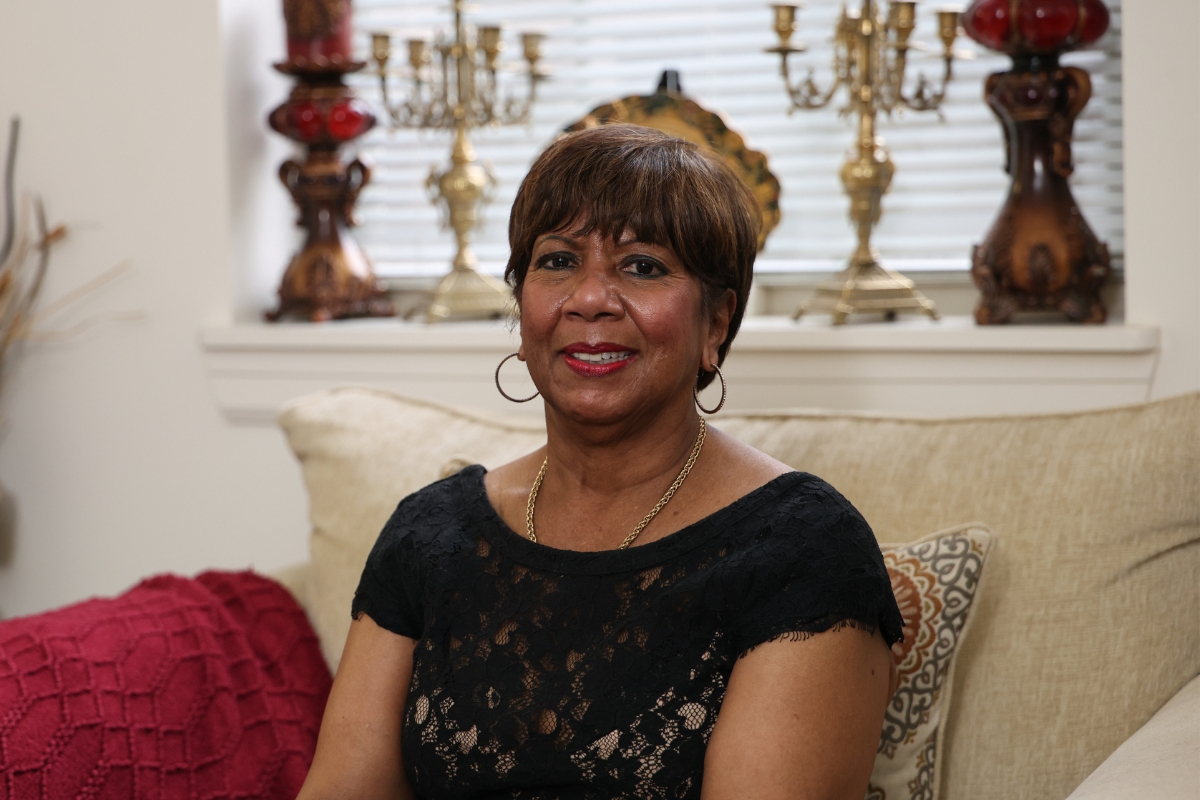
Walk into Carol Ramdehal’s home at Longfellow House in Roslindale and you will see care everywhere you look: from the art on the walls to the flowers in pots to the throw, in a color that matches both, neatly draped on the arm of an overstuffed chair. You’re immediately comfortable, and it’s not by accident—what you’re feeling is the expression of Carol’s love and appreciation for her surroundings. Everything is in its place. Nothing about it looks taken for granted.
Ask her how she likes living at Longfellow, and she will make the point much more explicitly.
“This place is my home,” she says, emphasizing the word. “Every day I give God thanks for that. I wouldn’t leave here.”
She goes on to describe a long list of qualities—from the safe, quiet neighborhood where she likes to walk to the friends she’s made in the building—that make Longfellow House a sanctuary for her. The depth of her gratitude might make you wonder whether Carol had ever been unhoused—she hasn’t. She has, however, endured changes in her circumstances that are both radical and not at all uncommon.
About a dozen years ago, Carol sat alone in a room in her sister’s Dorchester apartment. Her two sons were grown, and her marriage had recently ended, forcing her to leave her home of nearly two decades. Overnight, it seemed, her life had narrowed down to this room. While she was grateful to have a place to sleep at night, it was so much less than what she’d had—and what she needed.
“It was tough,” she confesses. “I used to sit in the room and cry a lot, and think, this is what my life came to.”
It had been a long journey to that lonely point, starting with a move to Boston from Trinidad with her husband and two young children. That leap of faith into a new country and new culture was powered at first by her husband’s tireless work ethic. His dedication to his job as a security guard at a West Roxbury condominium led to an invitation from the development owners to live on-site with his family. All at once, the challenge of living in one of the most expensive housing markets in the country was solved in a way they’d never dreamed. They moved into a new two-bedroom unit adjoining the complex’s clubhouse, overlooking a swimming pool and surrounded by quiet, wooded conservation land.
Their new home, however comfortable, provided more than simply a roof over their heads—they also became part of a community. As her husband took on even more work detailing cars for other residents, Carol dove into the working world herself for the first time in her life. Neighbors began to rely on her for housekeeping services. Already a friendly face and trusted member of the community, she was seldom at a loss for work, neatening and beautifying the homes of others while making a home for her own family as well.
But that was in the past. From her sister’s apartment in Dorchester she continued to do housekeeping work for people at her old condo complex, but they were now clients more than neighbors—and she had to string three bus lines together into an hours-long commute to reach them. She shudders when she recalls the long bus stop waits on winter nights.
“I stayed there with my sister for four years,” Carol says. “Every day I would get up and do what I had to do and just go back and lock myself in the room.”
This kind of isolation and loneliness is all too common among older adults. And it’s not just sad to see—it also comes with real health implications. The National Council on Aging notes that social isolation and loneliness put older adults at risk for a wide range of health issues, from hypertension and heart disease to depression, cognitive decline, and even death. Widely cited research out of Brigham Young University shows that lacking social connection can be as harmful to physical health as smoking up to 15 cigarettes a day.
As withdrawn as she’d become, Carol remained connected to her two sons, one of whom worked at Rogerson Communities. He urged her to apply for an apartment of her own at Longfellow House, a residence that was both affordable and much closer to her clients. She followed his advice—the staff there walked her through the application process, helped her with the paperwork, and she settled in to wait for a space to become available.
The following year brought a day she will never forget, when she learned that an apartment was finally available for her at Longfellow. When she arrived and the property manager opened the door to show it to her, light streaming through the seven-foot-high windows of the living room, she was overcome.
“They said, okay, if you like this place, this is yours,” she recalls. “When they told me that, I literally fell to my knees. I fell to my knees and I just started thanking God for giving me a place to live.”
For the past eight years Carol has called Longfellow House home, making her gratitude plain not only in words but in the coordination and style of her surroundings. They’re what you would expect of a housekeeper’s abode, thanks largely to years of taking inspiration from her clients’ homes.
Just as at the condominium years before, however, it would take more than nice décor to make her new apartment into a home. When she first moved in, Carol says, she kept largely to herself out of habit. That gradually changed, starting with visits from two women who would travel the hallways pushing a cart loaded with groceries to offer to residents who needed them. Carol would chat politely with them when they came by, then close her door. Yet after a while, that began to change.
“I started talking more and coming outside, and now it’s like everybody here is my family. They’re there for you. We all are there to support each other, no matter what. That is how I started opening up.”
Today, Carol is a regular at Longfellow House social gatherings like game days and food pantry, a free food donation program offered in partnership with a local church. And she is once again part of—and supported by—a vibrant community that values her. A community where she belongs.
“This is where I want to be,” she says. “This is where I am going to stay. I come home and I’m at peace.”