Local Color
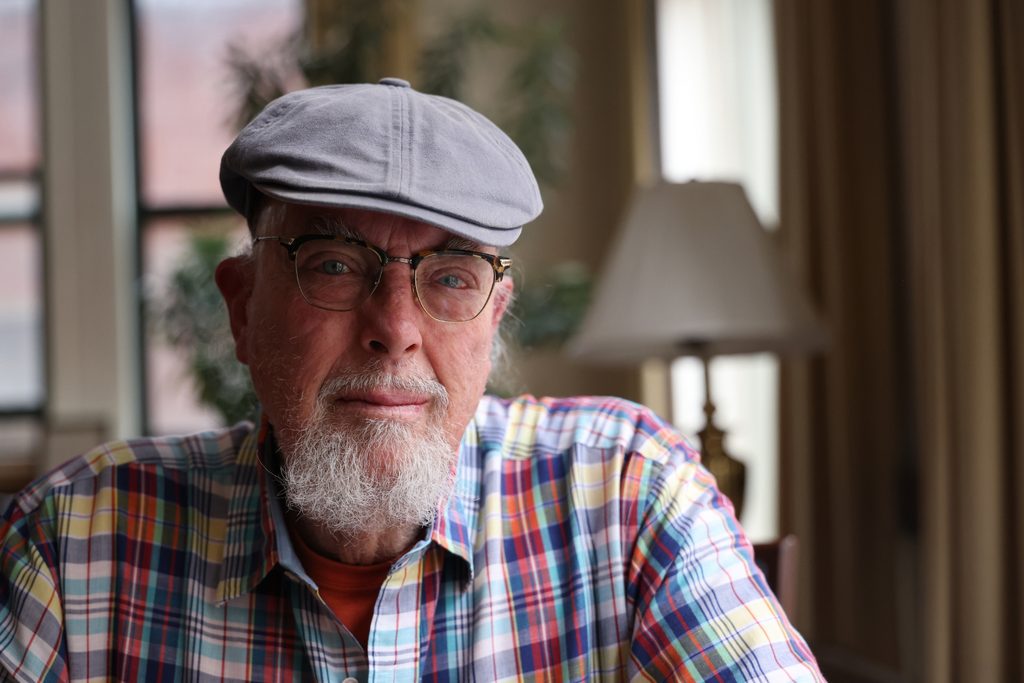
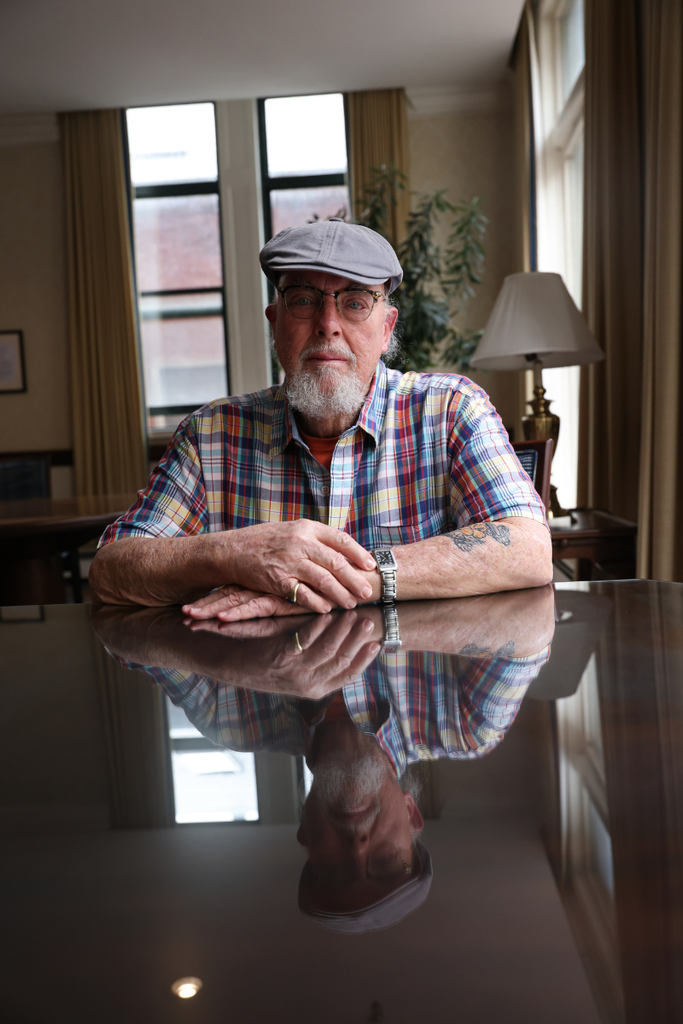
When it came time for him to retire, Jim Higgins headed in a direction precisely opposite that of many older adults: north, from his home in Florida to Boston.
What would draw a person away from the perpetually sunny beaches and golf courses of the nation’s retirement coastline to the often chilly heart of the northeast?
As it happens, Jim and Boston go way back.
In July of 1969, Jim had hit a dead end. More precisely, he was stranded in Islip, New York, midway across the broad expanse of Long Island. He had no particular business there—just doing some aimless wandering on a summer break from Broward Junior College, and making the entire journey by hitchhiking. On airplanes.
As unlikely as it seems today, there was a time when this was possible, a time of looser regulations and fewer questions. Jim had read news stories of young people traveling the country for free by showing up at airports and asking the pilots and crews of private aircraft, “Going my way?”
Often enough, the answer was yes. But not always.
This left Jim unable to secure a flight out of Islip, and getting desperate. He phoned a former girlfriend who was living in Boston and pled his case for a ride back home. He didn’t get it, but he did get an offer of lodging if he could make it to Boston on his own. So he hitched there the old-fashioned way, arriving at her Beacon Hill apartment on July 20. He remembers the date so well because he, she, and her roommates watched a news broadcast of the first lunar landing on television that evening.
“So I landed in Boston and Neil Armstrong landed on the moon,” Jim says, grinning at the recollection.
For Jim, setting foot on Beacon Hill was almost as momentous as humanity’s first journey beyond Earth. He discovered a new world that he fell in love with, its brownstones and lamplit cobblestone alleys reminding him of London. The following day, a friend took him to a building at 40 Joy Street that had once been a horse barn and carriage house, and was now an artists’ studio. It belonged to a young painter and illustrator named Bob Kennedy (who, while unrelated to the Massachusetts political dynasty, was swiftly becoming known in the local art scene). Jim still remembers how the space captivated him.
“I said to Bob, ‘Jeez, if I move up here, could I work here?’ He said, ‘Sure, come on up. I’ll give you a job.’”
Jim headed back to Florida to wrap up his affairs there and returned to Boston a quickly as he could, this time ready for a much longer stay. He made his way back to the Kennedy studio and announced to Bob that he was ready to get to work.
“I don’t think he even remembered me! He kind of scratched his head and said, ‘Well, go over there and run the silk screening.’ And I did. And that was the beginning of the best part of my life.”
While its historic character has endured over the centuries, the Beacon Hill of the early 1970s was very much not the exclusive address that it is today. It was both a hippie-friendly bohemian enclave and a gritty quarter of town where street prostitution and stickups were not uncommon. It was also affordable, especially for people with limited means like students and artists. Jim was both, enrolling at various times at the Art Institute of Boston and the Harvard Extension Program before graduating from the Massachusetts College of Art.
Over the next six years, Jim made a home for himself on Beacon Hill—several actually, living everywhere from Pinkney Street to South Russell Street to Joy Street. He opened a small art studio of his own at 20 Myrtle Street, opposite a large rooming house called Beacon Chambers that was home to working-class men who had no families. In the spirit of creative entrepreneurship, he also used the space to run a secondhand shop.
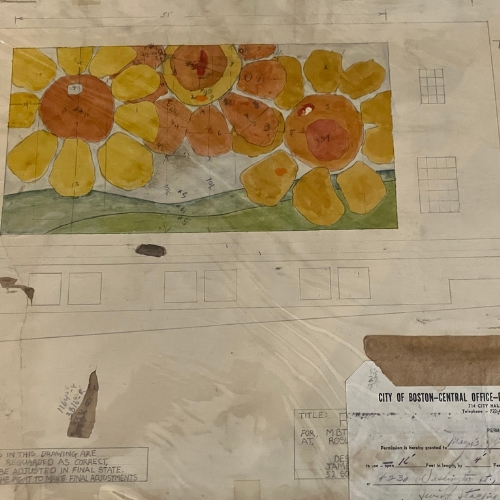
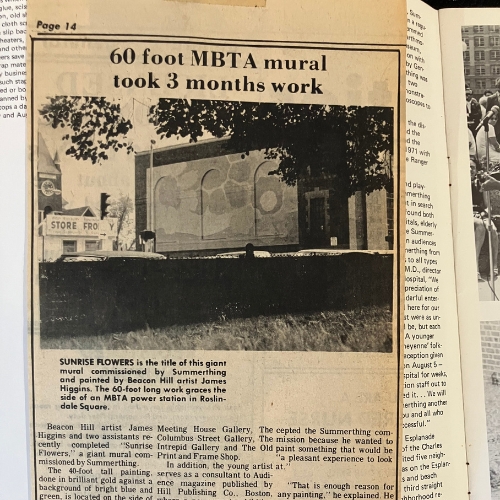
He supported himself with his shop and his art, brightening Boston communities by accepting commissions to paint murals around the city. He decorated buildings from downtown to Jamaica Plain—one of the largest spanned the side of an MBTA power substation in Roslindale Village, where he covered its bare brick with vivid, 20-foot-high flowers.
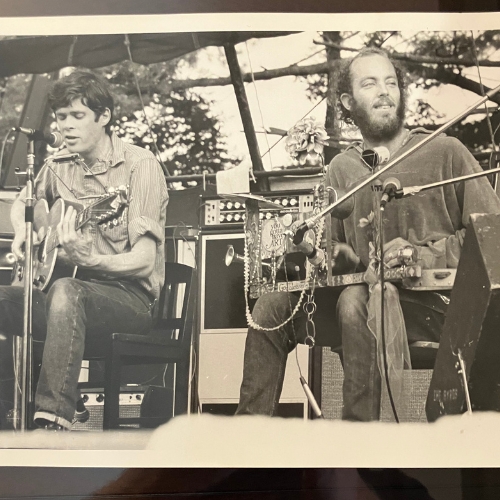
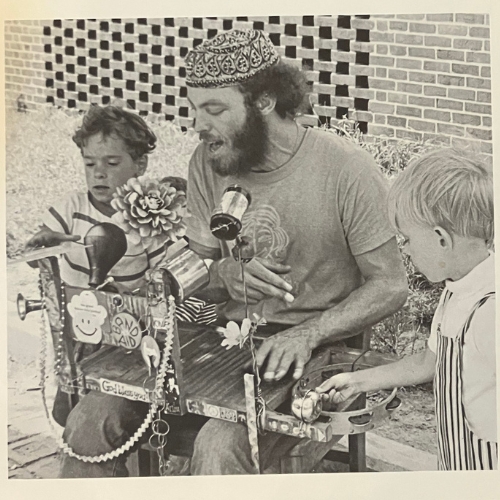
Jim’s artistic talents weren’t confined to visual arts though; he also became known around town for his “one-man band” performances on a washboard that he adorned with a jumble of bells, bicycle horns, cymbals, and other noisemakers. He put the contraption to regular use during Summerthing, a citywide music and arts festival held annually during the 1970s to bring the arts directly to the people. For several weeks each summer, the city would send dancers, visual artists, and musicians of all kinds to set up shop in neighborhoods from Charlestown to Hyde Park. Jim traveled throughout Boston during these festivals, often inviting children to join in—the city gave him a budget for materials so they could make their own “one-man-bands.” Sometimes he even found his way up onto stages with the likes of Spider John Koerner, onetime mentor to Bob Dylan, for Summerthing performances.
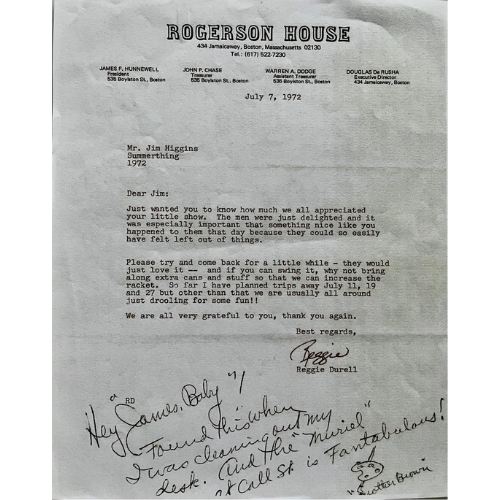
A particularly warm welcome, Jim recalls, came from the crowd at a home for older men in Jamaica Plain, a place called Rogerson House, where he brought a troupe of local children with him to put on shows.
“Somehow I really appealed to all the old folks,” he says. “I’d bring the kids in and we’d play and do sing-alongs. It was a big hit.”
Jim’s life in—and love of—Boston was a two-way street. He enjoyed himself immensely during those years, yet he also worked hard to add vibrancy and positivity to public life in an era when it was sorely needed. It ended, sadly, too soon, when he was drawn back to Florida to care for his ailing mother. Then came a career and a family of his own. It would be over four decades before he reunited with Boston.
Jim returned to Beacon Hill in 2018. While his love of the city hadn’t changed over the years, he discovered that his old neighborhood most certainly had. Gone was much of the crime and grit, but the populist vibe had given way to exclusivity as well—rents had skyrocketed to become some of the most expensive in the state. In the middle of all that exclusivity, however, he discovered a kind of island, at once familiar and unfamiliar: the Beacon Chambers rooming house on Myrtle Street, now known as Beacon House.
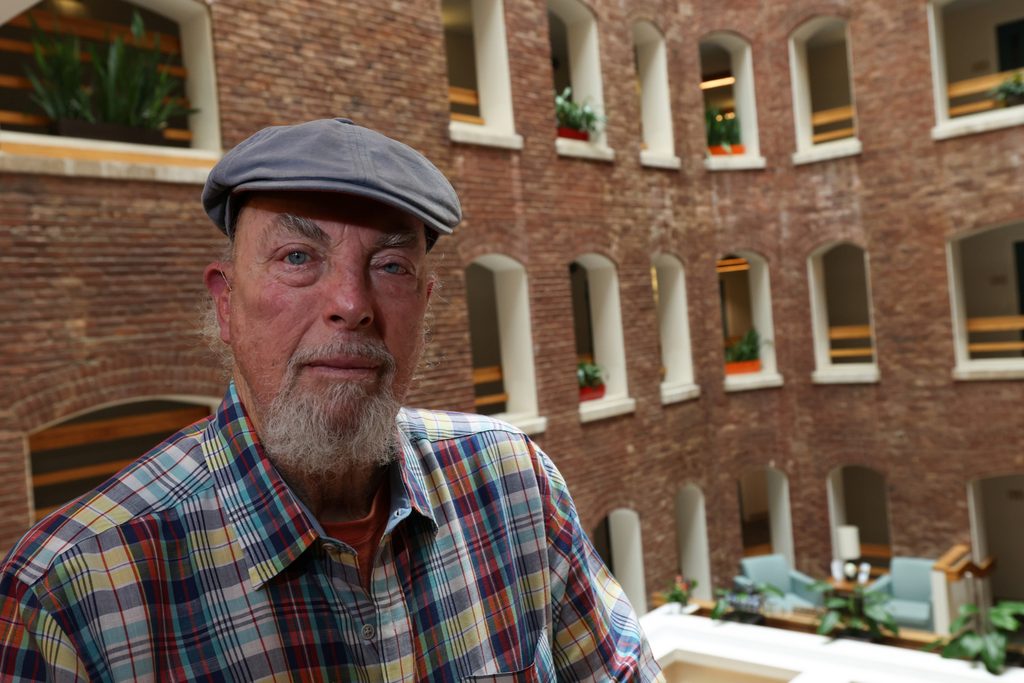
“I remembered this place when I came in,” he says. “I said, ‘Wow, this is different!’ It was really nice. The lobby was beautiful.”
During Jim’s absence, Beacon Chambers had suffered a nearly catastrophic fire, and was headed toward redevelopment as luxury condominiums before Rogerson Communities led an effort to preserve it as mixed-income residences for older adults. A reconstruction and renovation yielded 85 new affordable homes. That meant that, though he was now reliant chiefly on social security, there was still a place for him on Beacon Hill, this time as a resident of Beacon House.
Reminders of his past are everywhere: his former studio across the street, the space that was the Kennedy studio around the corner. A couple of Bob Kennedy’s paintings even hang in Beacon House’s library. And though the neighborhood has changed, he has found a thriving new community once again in the staff and fellow residents of Beacon House.
“This is a great place,” he says. “It’s very well managed. It’s clean—Andre and Eric, they take good care of the place. All kinds of neat people to be around.”

While he no longer has an art studio space, Jim finds other ways to contribute to the life of the community, often dressing up as Santa during holiday parties in the Beacon House community room. And his trusty one-man-band is still close at hand after all these years, just in case.
“Boston is a major part of my life and it’s the greatest city I’ve ever been in—I love it here,” he says. “To be able to be here at Rogerson when I was trying to kind of find my niche again, I found it at Beacon House.”